
Slow vs Traditional Squat Tempo to Failure: What the Study Found
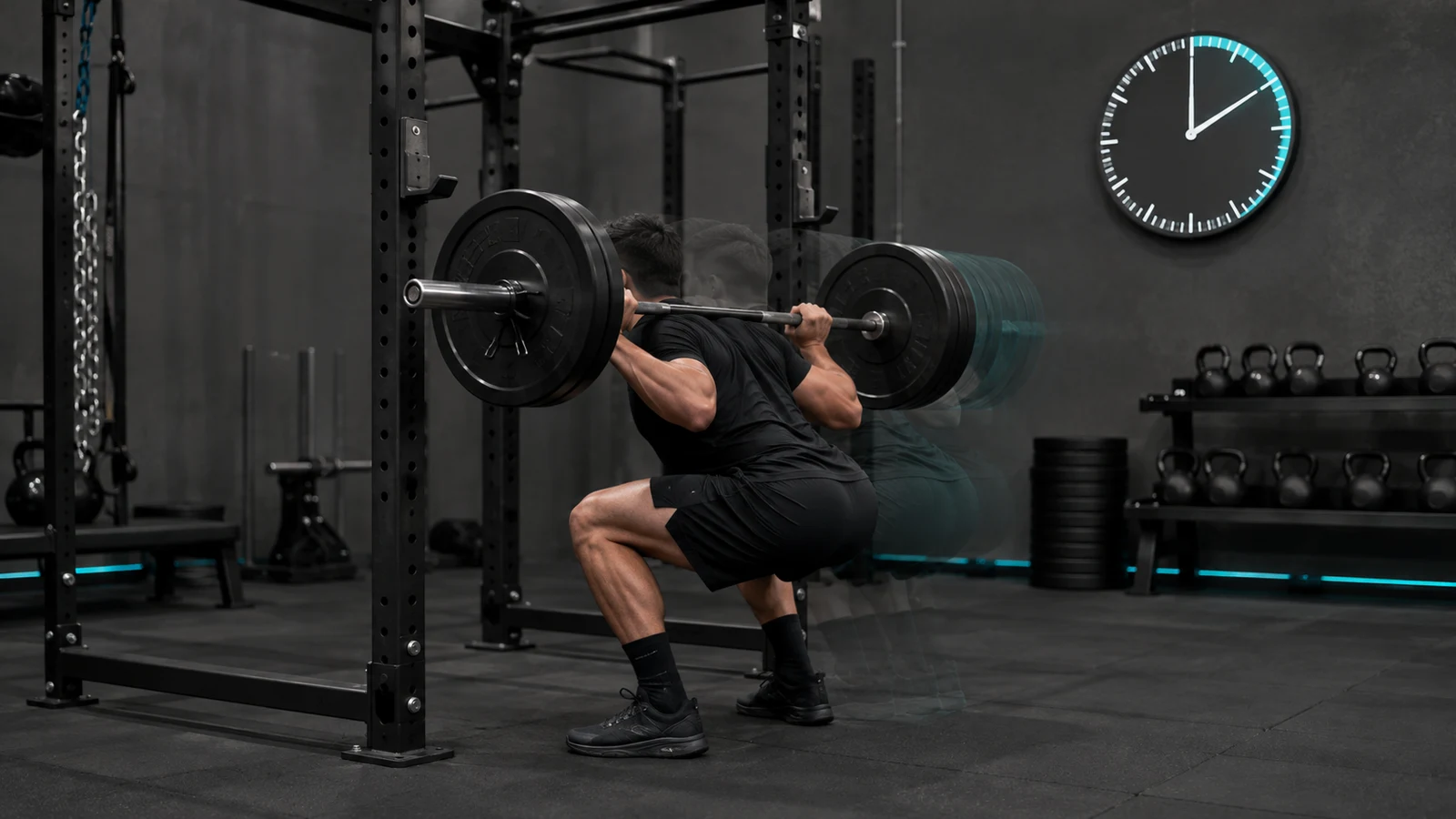
Slowing every phase of a squat changes what limits the set. In a new crossover study, traditional-tempo squats taken to failure produced more total volume load and a higher heart-rate response, while slow-tempo squats created more time under tension, longer muscle deoxygenation, and a stronger marker of anaerobic metabolic stress.
That is not evidence that one tempo builds more muscle. The experiment measured acute responses during two sessions, not growth or strength after months of training. Its useful lesson is narrower: when effort ends at failure, repetition speed redistributes mechanical, cardiovascular, and metabolic demands.
How the squat comparison worked
The PubMed-indexed study used a repeated-measures crossover design with 30 resistance-trained adults: 22 men and eight women. Each participant completed both conditions, which reduces noise from comparing different groups.
Both sessions involved three sets of barbell squats taken to muscle failure. The traditional condition used a two-second eccentric and one-second concentric phase. The slow condition doubled both phases to a four-second eccentric and two-second concentric.
Researchers measured volume load, time under tension, energy expenditure, heart rate, respiratory quotient, net carbon-dioxide release, and muscle oxygen saturation. Because both conditions ended at failure, the study compared two ways of reaching a hard endpoint rather than easy work against hard work.
Traditional tempo produced more volume load
Total volume load was significantly greater with the traditional tempo. A faster repetition cycle allowed participants to complete more load-repetition work before failure.
That result is intuitive but important. “Training to failure” does not equalize every feature of a set. Failure after a larger number of brisk, controlled repetitions can accumulate more external work than failure during deliberately prolonged repetitions.
Heart rate was also higher in the traditional condition. The authors described the faster rhythm as maximizing cardiovascular pressure and total volume load under the tested protocol. This does not mean faster is always better or that uncontrolled bouncing is useful. The traditional repetitions still used a specified two-second lowering phase and one-second lift.
Slow tempo extended tension and hypoxia
The slow condition produced more total time under tension. Each repetition lasted about twice as long, so the muscles remained loaded longer even though fewer repetitions could be completed.
The slow sets also increased net carbon-dioxide release and the area under the muscle-oxygenation curve, which the researchers interpreted as greater anaerobic metabolic pressure and a longer period of local hypoxia. Energy expenditure and respiratory quotient did not differ significantly between conditions.
These measures describe the immediate environment of the session. They do not prove that a longer burn or lower oxygen reading causes more hypertrophy. Acute physiological signals are mechanisms to study, not direct substitutes for long-term outcomes.
Why the tempos feel so different
A slow eccentric and concentric reduce opportunities to use momentum and stretch-shortening behavior. The lifter must sustain force through more of the range and cannot cycle through the easiest positions as quickly. Local discomfort and breathing demand can rise even while the number of completed repetitions falls.
At a traditional controlled tempo, each repetition consumes less time. The lifter can accumulate more repetitions and therefore more total volume load before the same endpoint. Heart rate may climb because work is being completed at a higher rhythm.
Neither condition eliminates technique. A six-second repetition can still drift out of position, and a three-second repetition can remain precise. Tempo is a programming variable, not a replacement for bracing, depth, balance, or load selection.
What the study cannot tell us
The experiment does not establish which tempo causes more muscle growth, strength, or fatigue across a training block. It did not compare recovery 24 or 48 hours later, and it did not test whether either method preserves better performance in subsequent exercises.
The sample was trained, but 30 participants remain a limited basis for subgroup claims. Results from back squats may not transfer directly to curls, machines, Olympic lifts, or rehabilitation exercises. Taking every squat set to failure also differs from how many lifters program heavy compounds.
Most importantly, the conditions changed repetition duration while keeping the endpoint at failure. A lifter who matches repetitions rather than effort, or matches time under tension rather than sets, is asking a different question.
Practical programming options
Use a traditional controlled tempo when load progression, repetition practice, and total work are the priority. A roughly two-second lowering phase with a deliberate concentric keeps the set repeatable without turning the barbell into a metronome exercise.
Use slower work selectively when you want to constrain momentum, increase positional awareness, or create a hard stimulus with less external load. It can be useful during technique blocks or on stable exercises where prolonged tension is the goal. Because slow failure sets are uncomfortable and locally demanding, start with fewer sets than you think you need.
Do not infer that more time under tension must beat more volume load. Hypertrophy can occur across a range of repetition durations when sets are sufficiently hard, but extremely slow lifting may reduce usable load and total repetitions. The best tempo is the one that supports the intended exercise, range of motion, effort target, and weekly progression.
The site's earlier reviews of failure versus one to three RIR and failure versus two RIR reinforce the same idea: an endpoint is only one part of a set. Tempo determines how you arrive there.
This study shows a tradeoff, not a champion. Traditional squats delivered more external work and a higher heart-rate response. Slow squats delivered more sustained tension and local metabolic pressure. Choose the stress that fits the program, and judge success by repeatable progress rather than by which set feels most brutal.
More Training
 Training
Flywheel Training Microdosing: One Set Daily vs One Weekly Session
A six-week trial split the same 30 flywheel leg-press sets into daily microdoses or one weekly session. Strength gains were similar, but soreness and architecture differed.
 Training
Resistance Bands vs Free Weights for Older Adults: Results of a 12-Week Trial
A 12-week randomized trial found that elastic-band and free-weight programs both improved several functional tasks in adults around age 67, with no clear overall winner.
 Training
Training to Failure vs 1–3 RIR: What the New Preacher-Curl Study Found
An eight-week within-person study found similar biceps growth and preacher-curl strength when trained lifters reached failure or stopped with one to three reps in reserve.