
Flywheel Training Microdosing: One Set Daily vs One Weekly Session
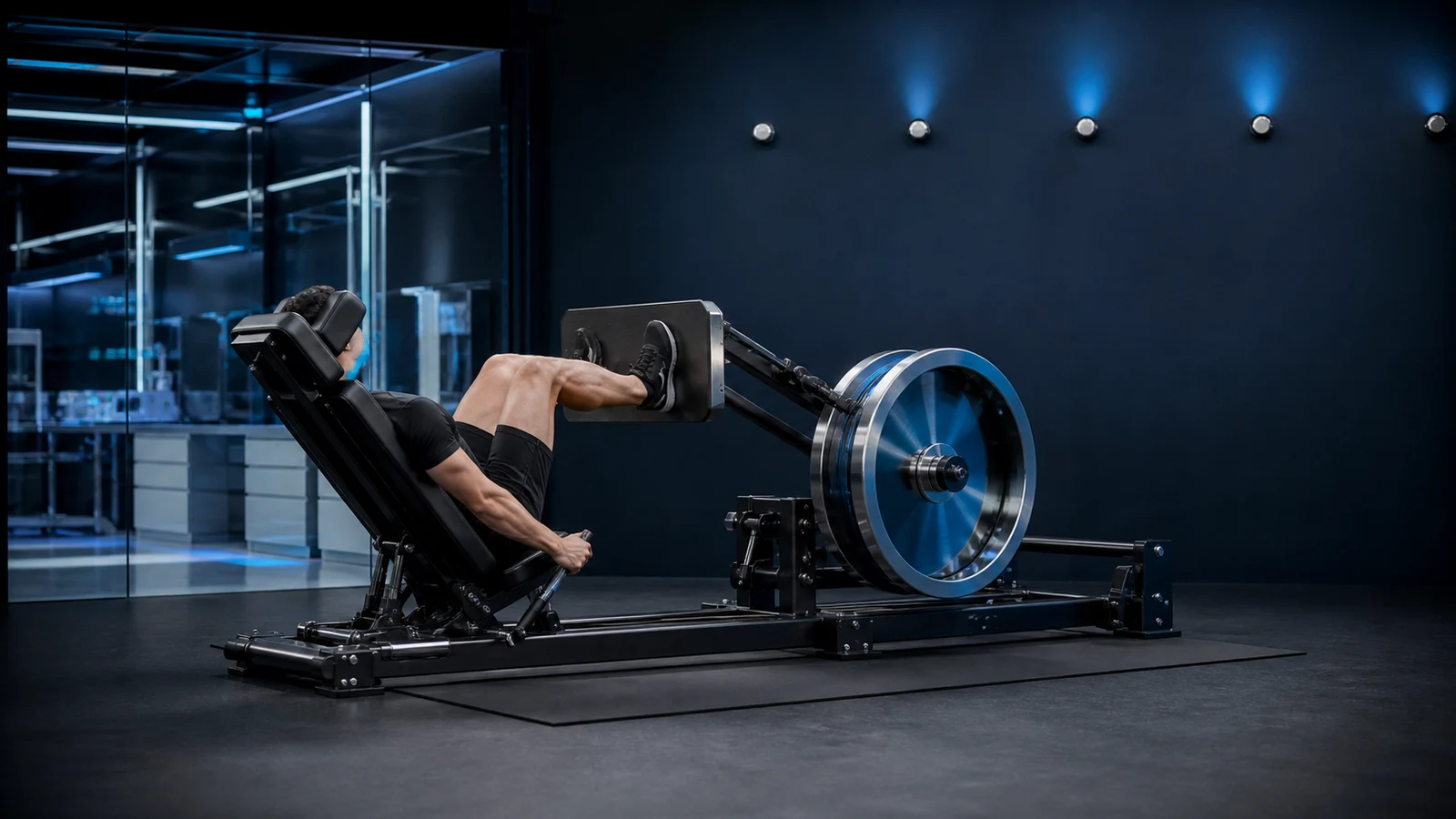
Splitting flywheel leg-press training into one set on five days per week produced similar strength and countermovement-jump gains to doing five sets once per week, but the daily “microdosing” schedule generated lower perceived effort and soreness. It also produced significant changes in several muscle-architecture measures that did not appear in the weekly-session group.
The six-week study is a useful test of frequency because weekly volume was equalized. It does not prove that daily training is universally superior. It suggests that distributing the same specialized work can change tolerability and some adaptations without necessarily changing every performance outcome.
How the study distributed 30 sets
The PubMed record describes 30 active participants randomized to two flywheel resistance-training schedules. Both groups completed 30 sets over six weeks on a flywheel leg press.
The microdosing group performed one set per day across five weekly sessions. The comparison group performed all five weekly sets in a single session. Total set count was therefore matched while frequency and per-session dose differed sharply.
Researchers assessed vastus lateralis and rectus femoris muscle thickness, vastus lateralis fascicle length and angle, half-squat maximal voluntary isometric contraction, countermovement and drop-jump performance, rating of perceived exertion, and delayed-onset muscle soreness.
Flywheel resistance is not identical to a plate-loaded leg press. The rotating disk stores energy during the concentric phase and returns it during the eccentric, allowing a strong braking demand. That makes the results most directly applicable to flywheel programs.
Muscle architecture favored the microdosing schedule
The microdosing group showed significant increases in vastus lateralis thickness of 9.8 percent and rectus femoris thickness of 7.9 percent. Fascicle length increased 11.8 percent and fascicle angle increased 14.2 percent. The once-weekly group did not show significant changes in those measures.
That pattern is interesting, but it should not be converted into a guaranteed hypertrophy advantage. Thirty participants split between two groups produce imprecise estimates, and ultrasound architecture measures are not the same as whole-leg muscle mass. The abstract also emphasizes within-group significance; direct between-group effects and confidence intervals remain important when judging whether the schedules truly differ.
The most defensible conclusion is that the distributed schedule produced clear architecture changes under this protocol while the concentrated schedule did not.
Strength and countermovement jump improved in both groups
Half-squat maximal voluntary isometric contraction improved by 27.4 percent in the microdosing group and 18.6 percent in the weekly-session group. Both groups also improved countermovement-jump height and a countermovement reactive-strength measure, with no reported between-group differences for those outcomes.
That means the larger numerical gain in one group should not be treated as proof of superiority. If the group-by-group difference is not statistically clear, the correct interpretation is that both schedules improved the measure and the experiment did not establish a reliable winner.
Daily microdosing did produce significant improvements in drop-jump reactive strength and take-off velocity, outcomes that were not highlighted as improving in the once-weekly group. Those results may matter to athletes who need rapid eccentric-to-concentric performance, but they still need replication.
Soreness and effort were lower with microdosing
The cleanest practical result may be tolerability. The microdosing group reported significantly lower ratings of perceived exertion and delayed-onset muscle soreness throughout the intervention.
Five sets in one session create a larger local dose than one set. Later sets are performed with more accumulated fatigue, and the entire stimulus lands on a single day. One daily set can be attacked while fresh and may create less disruption to the next practice.
That does not make five weekly visits free. Commuting, setup, and scheduling impose costs that a soreness scale does not capture. Microdosing is most practical when the device already sits in the athlete's training environment or when a one-set exposure can be attached to team practice or rehabilitation.
Why distribution may change adaptation
Equal sets do not guarantee equal repetitions, velocity, or eccentric overload. A fresh daily set may maintain higher output than the fourth or fifth set of a concentrated session. Better set quality could help explain the architecture and drop-jump results.
Frequent exposure also provides more chances to practice timing on the flywheel. Technical familiarity may influence output, especially over a short six-week study. Conversely, a concentrated session provides a longer single stimulus and more full rest days.
The study therefore compares complete scheduling strategies, not frequency in isolation. Set quality, fatigue, technique practice, and recovery pattern all move together.
How to apply microdosing without copying it blindly
Athletes with access to a flywheel can trial a small distributed dose during busy competition periods. Keep weekly volume stable at first, place the set after a consistent warm-up, and track output, soreness, and sport-practice quality. The goal is to redistribute work, not quietly multiply it.
For conventional resistance training, borrow the principle cautiously. A daily heavy squat set is not the same as one flywheel leg-press set. Exercise risk, setup, joint stress, and proximity to failure matter. Stable movements with low setup cost are better candidates than highly technical maximal lifts.
Compare the approach with the site's review of training frequency and volume. Frequency often works as a tool for arranging sufficient quality work rather than as an independent magic variable.
This trial makes the microdosing case most strongly on convenience for recovery: similar improvements in several strength and power outcomes, less perceived exertion, and less soreness. Its muscle-architecture results are promising. The next question is whether larger studies using conventional exercises reproduce them—and whether the extra weekly touchpoints fit real athletes better than one focused session.
More Training
 Training
Slow vs Traditional Squat Tempo to Failure: What the Study Found
A crossover study compared slow and traditional barbell squats taken to failure. The tempos redistributed stress rather than producing one universal winner.
 Training
Resistance Bands vs Free Weights for Older Adults: Results of a 12-Week Trial
A 12-week randomized trial found that elastic-band and free-weight programs both improved several functional tasks in adults around age 67, with no clear overall winner.
 Training
Training to Failure vs 1–3 RIR: What the New Preacher-Curl Study Found
An eight-week within-person study found similar biceps growth and preacher-curl strength when trained lifters reached failure or stopped with one to three reps in reserve.