
Food Order for Athletes: Carbs First or Vegetables and Protein First?
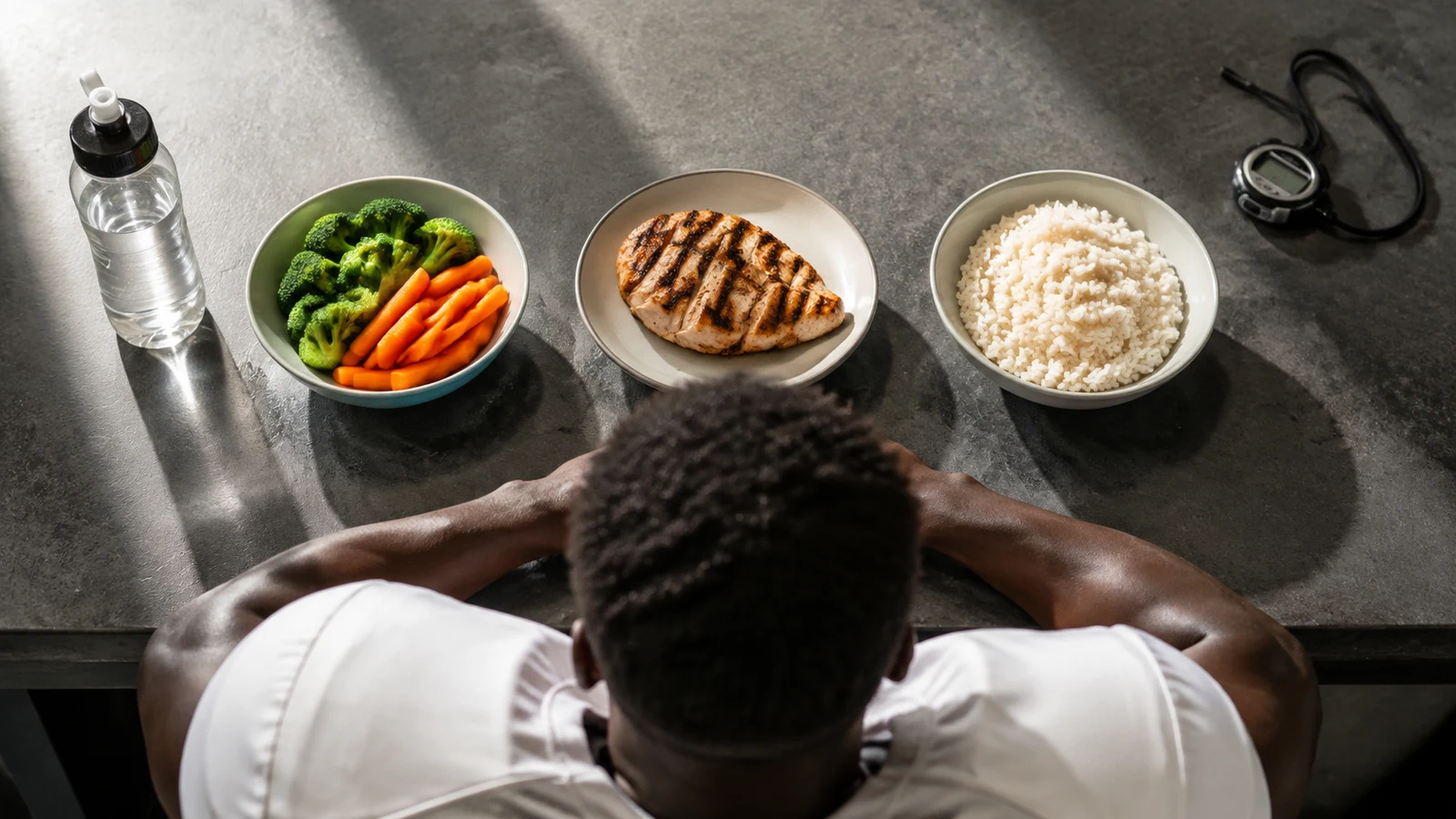
Eating the carbohydrate portion of breakfast last lowered the early post-meal glucose rise in a new trial of highly trained male football players. It also produced lower ghrelin, but—counterintuitively—participants reported more hunger, less satiety, and stronger cravings. They did not eat less during the later free-choice period.
The finding makes meal order a potentially useful fine-tuning tool, not a performance breakthrough. The study tested one breakfast in 14 athletes and followed responses for hours. It did not measure match performance, training adaptation, body composition, or long-term glucose control.
How the meal-order trial worked
The randomized crossover trial included 14 highly trained male football players with an average age of about 23. Each athlete completed two standardized-breakfast conditions, separated by one to two weeks.
In one condition, carbohydrate was eaten first. In the other, carbohydrate was eaten last, after the other meal components. Because the same participants completed both conditions, each athlete acted as his own comparison.
Researchers measured glucose, insulin, total GLP-1, GIP, ghrelin, PYY, triglycerides, non-esterified fatty acids, and appetite ratings for three hours. They then measured free-choice food intake during hours three through six.
Post-meal glucose was the primary outcome. The long list of secondary outcomes matters because a smaller glucose peak is not automatically the same as better appetite control or better sports performance.
Carbohydrate last reduced the early glucose response
Compared with carbohydrate first, the carbohydrate-last pattern reduced the glucose incremental area under the curve during the first 60 minutes by 54 mmol/L × minutes. The incremental glucose peak was 1.7 mmol/L lower.
This fits a plausible digestive sequence. Vegetables, protein, fat, and the physical structure of a mixed meal can slow gastric emptying and change how quickly carbohydrate reaches the small intestine. Eating carbohydrate after those components may blunt the early appearance of glucose in blood.
That effect may interest athletes or clinicians who want a smoother post-meal curve. It should not be treated as evidence that carbohydrate is harmful or that an athlete should delay it in every meal. Football demands high carbohydrate availability, and total intake remains central to glycogen restoration and training quality.
Hormones and lipids moved in mixed directions
The carbohydrate-last condition produced a higher GIP response and a lower total ghrelin exposure over three hours. Triglyceride incremental area was also higher.
These are not simple “good” or “bad” labels. GIP participates in the insulin response and nutrient handling. Ghrelin is often called a hunger hormone, but appetite is produced by interacting physiology, food cues, expectations, and behavior. A lower hormone value does not guarantee that a person feels fuller.
The higher triglyceride response may reflect the timing of mixed nutrients rather than a chronic health effect. One post-meal test cannot establish what repeated use would do to blood lipids over weeks or months.
Hunger went up despite lower ghrelin
Participants reported greater mean hunger, lower satiety, and more desire for sweet and salty foods after the carbohydrate-last breakfast. That is the study's most useful caution against optimizing a single biomarker.
If an eating pattern lowers the glucose peak but leaves an athlete distracted by hunger, its real-world value may be limited. The subjective differences were modest, yet they moved opposite to what a simplistic “lower glucose equals fuller” story would predict.
The later free-choice intake did not differ between conditions. In other words, greater reported hunger did not translate into a measured increase in food eaten during hours three through six. Feelings and behavior can diverge, especially in a controlled laboratory day.
What the study cannot answer
The sample included only men and was small. Responses in women, older athletes, people with diabetes, or athletes from endurance and strength sports may differ. The players were metabolically healthy, so the clinical importance of a lower early glucose rise is uncertain.
Only one standardized breakfast was tested. Meal composition, fibre, food form, total calories, training time, and glycogen status could change the response. Eating rice after vegetables is not the same intervention as drinking a recovery shake after a match.
No performance test followed the meal. We do not know whether carbohydrate order affected sprint capacity, skill, perceived energy, or recovery. The trial also did not compare long-term dietary patterns.
When carbohydrate-last may be useful
An athlete could use vegetables and protein first at a mixed meal when immediate carbohydrate delivery is not urgent and a smoother glucose response is personally useful. The change is simple, costs nothing, and does not require removing carbohydrate.
It is less attractive immediately before or after demanding training when rapid digestion and glycogen replacement matter. In that window, delaying a large carbohydrate portion—or loading the meal with fibre and fat—may create unnecessary fullness and slow intake.
People should also pay attention to appetite. If carbohydrate-last increases cravings or makes the meal less satisfying, the theoretical metabolic benefit may not justify the tradeoff. Individual response matters more than turning the order into a rule.
The site's review of carbohydrate and hypertrophy makes a related distinction: carbohydrate supports training and recovery, but a single manipulation should not be credited with outcomes it did not measure.
This trial shows that meal sequence can alter short-term physiology in athletes. Carbohydrate last flattened the early glucose response while producing a more complicated appetite picture. That makes food order a context-dependent option—not a reason to fear rice, and not a shortcut around total energy, protein, carbohydrate, and training design.
More Diet
 Diet
DietVegan Diet, Muscle Loss, and Resistance Training in Older Adults: New Trial
In a 12-week trial, a self-selected vegan diet reduced protein intake and muscle measures in adults over 65. Resistance training mitigated, but did not erase, the losses.
 Diet
DietCreatine With Resistance Training After 60: Strength, Muscle, and Function Evidence
A 2026 meta-analysis of 11 trials found a modest strength benefit when adults over 60 combined creatine with resistance training, while muscle and function estimates remained uncertain.
 Diet
DietDo More Carbs Build More Muscle? What the 2026 Meta-Analysis Found
A 2026 meta-analysis found no clear independent hypertrophy advantage from higher carbohydrate intake when resistance-training studies were pooled, but the evidence remains limited.